
Arche Dialogue: Zhai You Explores the Aesthetic Divide Between Eastern and Western Painting Traditions

Toronto, August 21, 2025 — Glenmaura on Yonge Street, Headquarters of Arche Capital

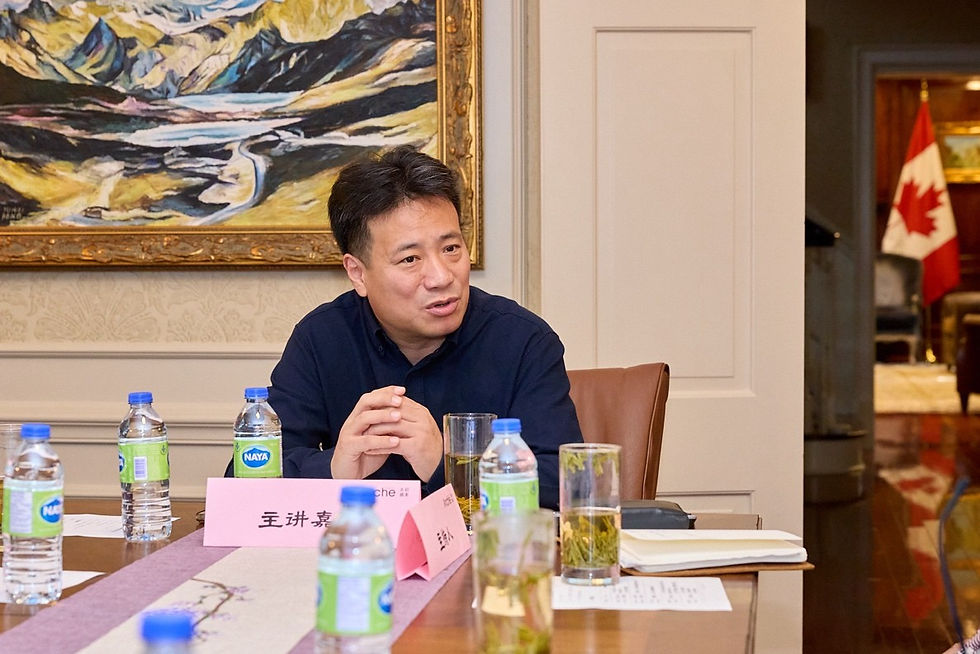
Arche Capital hosted the latest edition of its signature thought leadership series, Arche Dialogue, at its landmark Toronto headquarters. The forum featured a keynote presentation by Zhai You, President of the Jiangsu Chinese Painting Society, titled “Aesthetic Dialogues Between Chinese Ink Painting and Western Oil Painting.”
A Brush Through Time: The Legacy of Chinese Painting
Zhai You opened the session with reflections on the ancient tradition of Chinese painting, describing it as visual poetry of Chinese civilisation. With ink as its soul and rice paper as its medium, Chinese painting embodies philosophical ideals such as harmony between nature and humanity, and the pursuit of meaning beyond form.
From Gu Kaizhi's Admonitions of the Court Ladies to the solitary ink rhythms of Bada Shanren, and from the ethereal landscapes of the Song and Yuan dynasties to the modern resonance of the New Jinling School, Chinese painting has continuously expressed the spirit and aesthetics of its people.
Zhai emphasised that Chinese painting is not merely a technique but a continuation of thought. It values “emptiness,” “spirit,” and the principle that “brush and ink must follow the times,” unfolding infinite philosophical depth within finite space.

A Western Counterpoint: Oil Painting and Rational Realism
In contrast, oil painting emerged in Europe, grounded in humanist rationality and scientific observation. It constructs space through light and shadow and renders form and texture with vivid colour. From da Vinci’s Renaissance precision to Monet’s impressionist light, oil painting reflects the evolution of Western aesthetics and philosophy.
Zhai noted that oil painting offers a tactile experience. It invites viewers into the scene, sharing the artist’s visual perspective. Chinese painting, by contrast, offers an introspective journey, guiding viewers beyond the canvas into the artist's inner world.

The New Jinling School of Painting: Tradition Meets Modernity
Zhai highlighted the significance of the New Jinling School, a pivotal movement in the development of contemporary Chinese painting. As a leading figure in the school, he described its approach as a fusion of classical brushwork with modern composition and contemporary themes.
“Tradition is not a constraint but a foundation. Innovation is not a departure but a continuation,” he remarked.
Works from the New Jinling School often combine grand narratives with delicate technique, capturing both the majesty of landscapes and the intimacy of human emotion. This represents an aesthetic evolution of Chinese painting in today's cultural context.

Finding Resonance in Difference
Throughout the session, Zhai stressed that the comparison focused on classical Chinese and Western painting, rather than contemporary experimental forms. Only through tradition, he argued, can we truly understand the origins and uniqueness of each system.
Chinese painting and oil painting embody distinct philosophies: “Daoist naturalism” versus “rational order.” Their materials, techniques, and aesthetics differ, yet both have blossomed into profound artistic expressions within their respective cultural soils.
“These differences are not barriers,” Zhai concluded, “but starting points for dialogue. In comparison, we discover distinction; in distinction, we preserve identity; and in identity, we find resonance.”

Looking Ahead: Art in a Cross Disciplinary Future
As emerging technologies such as AI, Web3, and biotechnology reshape the world, art too is undergoing transformation. Chinese painting and oil painting are no longer confined to museum walls. They are becoming mediums for cross disciplinary expression.
Zhai expressed confidence that the future of art lies in fusion, anchored in tradition, yet open to the winds of change. Within the framework of Arche Dialogue, art becomes more than a visual experience. It becomes an extension of thought and a vibration of culture.


留言